

- astronomi
- Ay
- çocuklar için bilim
- Published
- Reading time
- 2 min read
Why Does the Moon Look Different Every Night? The Phases of the Moon
Sometimes the Moon looks like a thin crescent, sometimes like a full circle. Yet the Moon's shape never actually changes. What changes is how much of the half lit by the Sun we can see from Earth.
The Moon does not make its own light
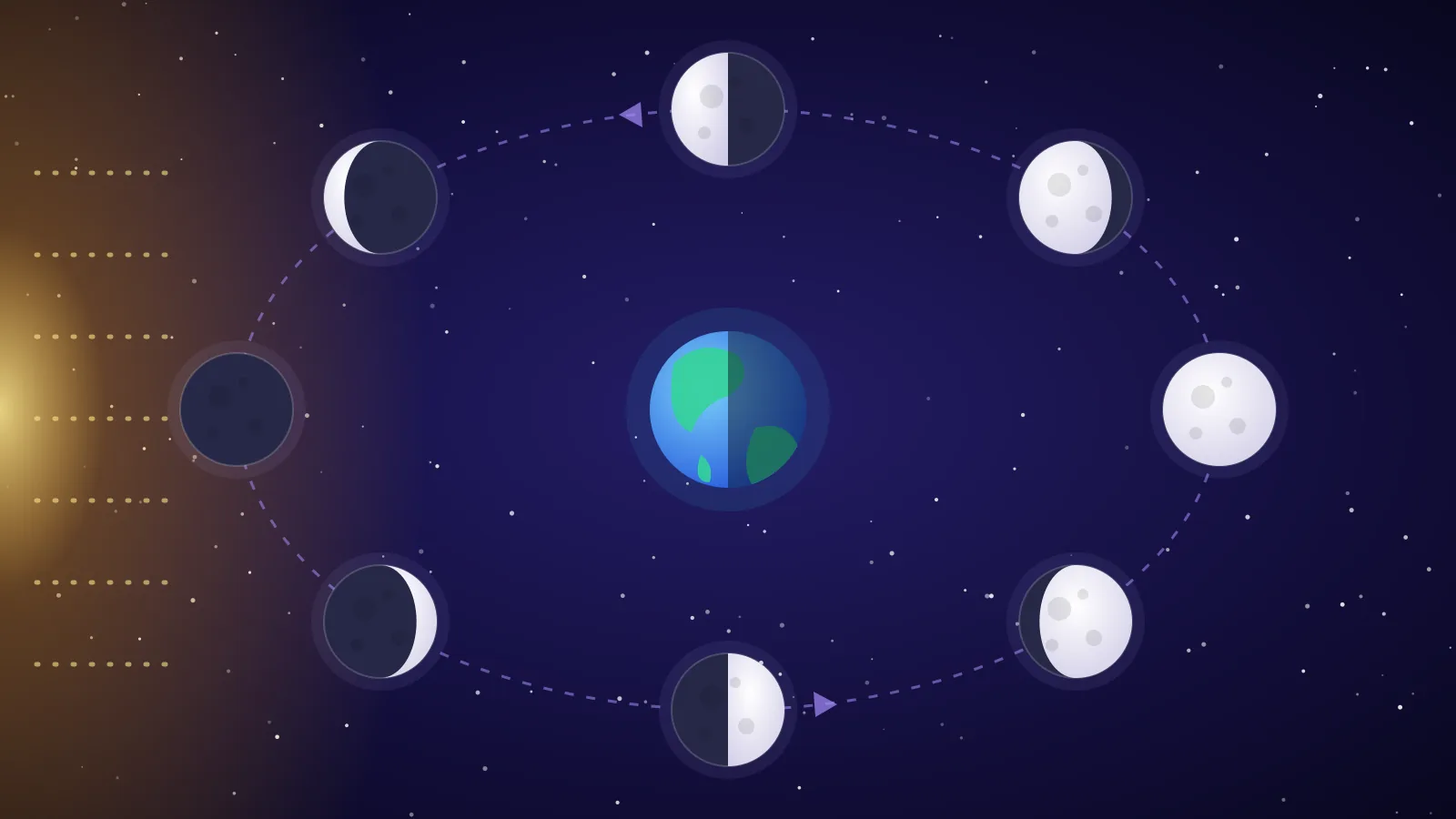
The Moon reflects sunlight. At any moment, the half of the Moon facing the Sun is lit and the other half is dark. As the Moon orbits Earth, we see that lit half from different angles.
The phases in order
- New Moon: The Moon is between Earth and the Sun; its lit side faces away from us, so we cannot see it.
- Waxing crescent: A thin arc appears in the west after sunset.
- First quarter: Half of the Moon looks lit.
- Waxing gibbous: More than half is lit, and the lit part keeps growing.
- Full Moon: Earth is between the Moon and the Sun, and we see the whole lit face.
- Waning phases: The lit part then shrinks; after the last quarter and the waning crescent, the cycle starts again.
About 29.5 days pass from one new Moon to the next.
A common mix-up
The phases are not caused by Earth's shadow. Earth's shadow falls on the Moon only during a lunar eclipse, which happens at full Moon when the Sun, Earth and Moon line up almost exactly.
Try it at home: a lamp and a ball
In a dark room, let a desk lamp be the Sun and a ball in your hand be the Moon; you are Earth. Face the lamp, hold the ball at arm's length slightly above your head and turn slowly on the spot. You will see for yourself how the lit part of the ball changes from crescent to full.
Observe for a month
Look at the Moon at the same time every evening and draw its shape. Because the Moon rises on average about 50 minutes later each day, there will be evenings when you cannot see it at all, and that is part of the observation too.